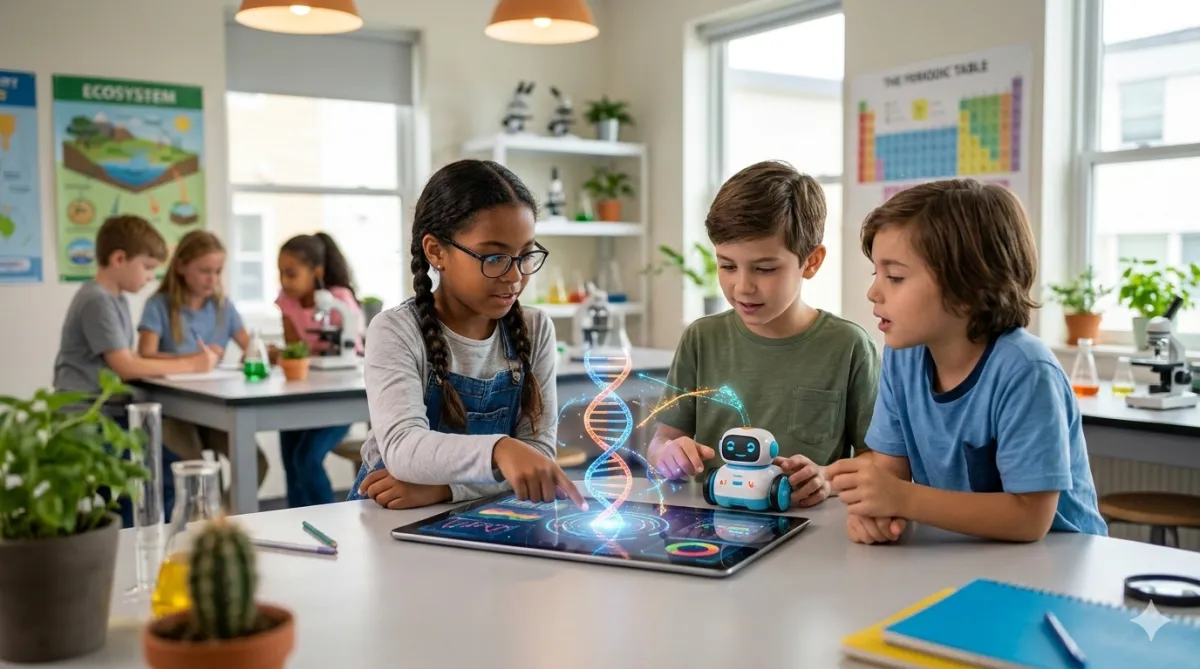
AI in Science Classrooms
Science has always been about curiosity, exploration, and discovery. Yet limited lab time, safety concerns, and resource constraints often hold students back. Artificial intelligence (AI) opens new doors for science classrooms, making experiments safer, simulations richer, and data analysis more accessible.
Rather than replacing hands-on labs, AI complements them — giving students more opportunities to explore scientific concepts.
1. Virtual Labs and Simulations
AI-powered virtual labs let students experiment without expensive equipment or safety risks. Simulations can replicate chemical reactions, physics experiments, or even molecular biology activities.
💡 Example: A high school used AI-driven chemistry simulations so students could safely explore reactions involving volatile compounds.
2. Data Collection and Analysis
Lab work often generateslarge amountsof data that can overwhelm students. AI helps by organizing results, flagging anomalies, and suggesting trends. This builds analytical skills while reducing frustration.
💡 Case study: Middle school students used AI to track plant growth over weeks. The AIidentifiedsubtle growth patterns that students later confirmed in their lab reports.
3. Personalized Science Learning
Some students grasp scientific concepts quickly, while others need extra reinforcement. AI platforms can adjust reading levels, provide hints, and generate practice problems tailored to each learner.
This keeps advanced students engaged while supporting those who need more guidance.
4. Connecting Science to the Real World
AI can make science relevant by linking concepts to real-world applications. Students can explore climate models, medical research simulations, or even space exploration through AI-driven platforms.
💡 Example: An astronomy class used AI to simulate planetary orbits, helping students visualize gravitational forces.
Conclusion
AI makes science classrooms more engaging,equitable, and effective. By combining hands-on labs with virtual simulations, supporting data analysis,and personalizing learning, AI helps students not only understand science — but experience it. The result is deeper curiosity, stronger skills, and a generation ready to solve tomorrow’s challenges.